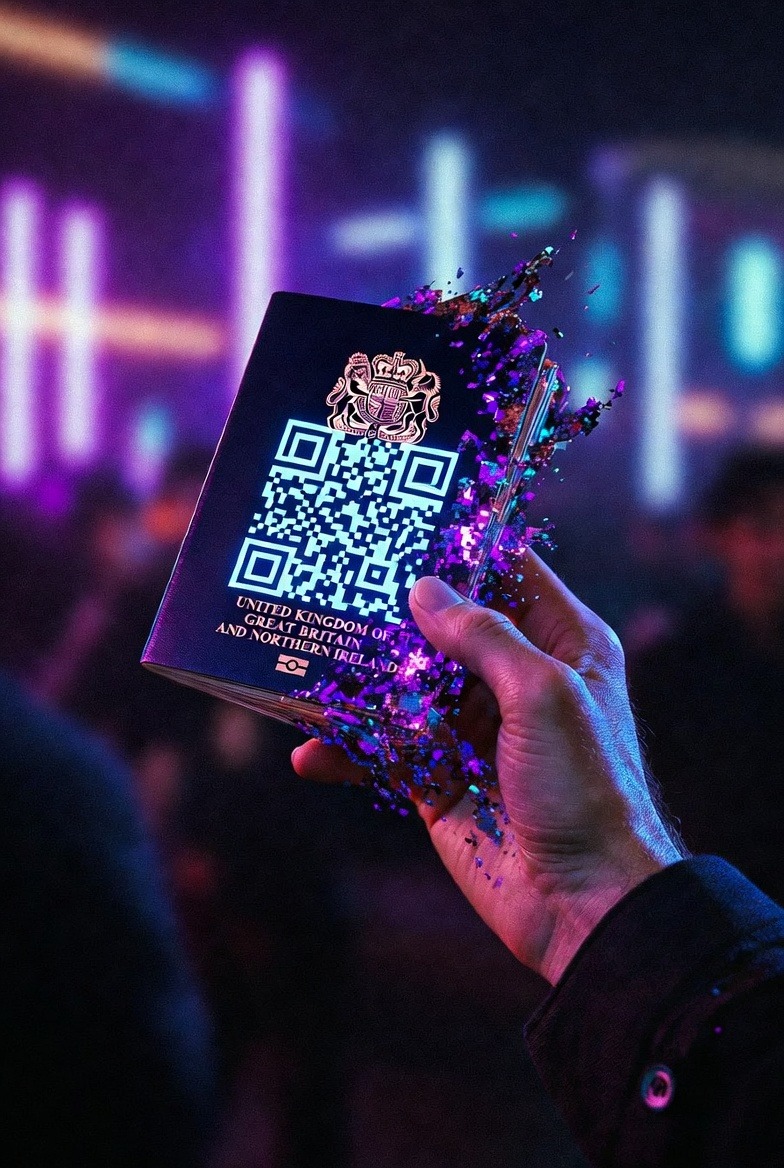
In January, the government announced it had “abandoned” plans for mandatory digital ID. Headlines celebrated. Campaigners claimed victory. And the machine kept building.
Here’s what actually happened: the compulsion didn’t disappear. It moved. You won’t be required to carry a digital ID — but by the end of this Parliament, every employer in the country will be legally required to run digital right-to-work checks. You’re free to refuse the ID. You’re just not free to earn a living without it touching you.
That’s not a U-turn. That’s a redesign.
Voluntary Is How Mandatory Arrives
No government in modern Britain will ever pass a law saying “citizens must carry identity papers.” We fought that battle over the 2006 ID card scheme and won it. The lesson Whitehall learned wasn’t “don’t do this” — it was “don’t do it like that.”
So the new model is voluntary. Free to download. Stored on your phone, “secure as a banking app.” The official explainer is a masterpiece of reassurance: no central database, you control your data, alternatives for people without smartphones.
And then, quietly, the perimeter closes:
Want a job? Your employer must verify you digitally. Want a pint? From autumn 2026, digital ID becomes valid age verification for alcohol in England and Wales — optional today, default tomorrow, as retailers standardise on the cheapest compliance path. Benefits, childcare, banking, age-gated websites: each sector gets its own “convenient” integration via the Digital Access to Services Bill now moving through Parliament.
Nobody mandates the frog into the pot. You just make the water comfortable and let network effects do the rest. When every checkout, landlord, employer and bank asks for the same credential, “voluntary” is a word that describes the law, not your life.
The Threat Isn’t the Card. It’s the Chokepoint.
Be precise about the danger, because it isn’t the technology. Cryptographic identity done properly — keys you hold, selective disclosure, no phone-home — is genuinely useful. That’s not what’s being built.
What’s being built is a chokepoint: a single credential that mediates your access to work, money, services and age-restricted life, operated under government-defined rules that can change with a statutory instrument. The threat model isn’t today’s minister. It’s the permanent capability handed to every future one.
We’ve just watched this movie in another theatre. In June, a US export order switched off two frontier AI models globally overnight — and switched them back on eighteen days later. One signature each way. The lesson wasn’t about AI. It was that centralised access is a switch, and someone else’s hand is on it.
A digital ID chokepoint is the same switch, wired to your identity. Once every employer verification, every purchase check, every service login routes through one credential, the infrastructure for conditional citizenship exists — regardless of whether anyone currently intends to use it. “We would never” is not an architecture. It’s a mood.
And the mood changes. Ask anyone whose bank account was closed for their politics, or who watched Canadian trucker-protest donors get frozen out of their own money in 2022. The tools get used because they’re there.
What “No Central Database” Actually Means
The government’s flagship privacy promise deserves scrutiny. “No centralised database of personal information” sounds decisive. But the ID scheme sits alongside GOV.UK One Login — a single sign-on across government services — and a planned UK Wallet for official documents. You don’t need one big database to build a surveillance capability. You need linkable identifiers and logging at the verification layer. Every time the credential is checked, somewhere a record can exist: who, where, when, for what.
Distributed storage with centralised observability is not privacy. It’s a database with better PR.
How to Resist — Practically, Legally, Now
Resistance here isn’t dramatic. It’s a set of unglamorous habits that keep the analogue paths alive and the pressure on. The paths only stay open while people use them.
1. Use cash, deliberately. Every cash transaction is a vote for an economy that doesn’t require identity to function. Cash is legal, private by design, and the single most effective everyday act against transactional surveillance.
2. Keep and use physical documents. Passport, driving licence, paper records. From autumn, when a checkout offers digital age verification, hand over the physical card instead. Friction is the point — acceptance rates are the metric that decides whether alternatives survive.
3. Respond to the consultations and the Bill. The Commons Library briefing is the best neutral summary of where the legislation stands. Write to your MP about the Digital Access to Services Bill — specifically demanding statutory guarantees: no verification logging, true offline alternatives with equal legal standing, and a prohibition on private-sector demands for the ID where physical documents suffice. The January climbdown proved pressure works.
4. Support the organisations doing the heavy lifting. Big Brother Watch and the Open Rights Group have fought this fight since the 2006 scheme. They killed mandatory ID once. Fund them.
5. Master the tools of self-sovereign identity. Encryption, keys you control, money you custody. The skills compound. A population fluent in cryptographic self-custody is structurally harder to herd through a single government credential — and if the state ever offers genuine self-sovereign ID (keys on your device, zero-knowledge age proofs, no logging), the people who understand the difference will be the ones who can tell.
6. As an employer or director, choose maximum-privacy compliance. Those of us who run companies will be conscripted as enforcement points. Comply with the law — and implement it with minimum data retention, no gratuitous identity harvesting, and documented pushback through trade bodies. Conscripts can still drag their feet.
The Line Worth Holding
I’m not against digital identity. I’m against this shape of it: state-defined, employer-enforced, scope-creeping, observable at the point of verification, and sold as voluntary while the exits are bricked up one by one.
Rights that depend on infrastructure are only as durable as the infrastructure’s owner is benevolent. The British instinct — the one that killed ID cards — was never anti-technology. It was the older, sounder instinct that the state serves the citizen, and a citizen who must be verified to work, buy and exist has quietly become the servant.
The water is warming slowly, and comfortably, exactly as designed. Get out of the pot.
Leave a Reply